
Balkan Unscripted #20 - Scuttling Ships in Greece, the End of Schmidt and a Shooting


Dear all,
I (Ingrid) have a fun holiday hobby — stalking ships on Shipfinder.
This week – whilst laying on a sandy beach in a small town in the Greek Peloponnese – I wasted some time reading about the Athens Voyager, a 237 meters long oil tanker sailing under the flag of Panama, currently slowely cruising the Aegean Sea. Past Santorini and Mykonos – it’s due to arrive in the Turkish city of Canakkale tomorrow.
I am quite obsessed with such ships – from the exotic locations they set sail from and to; the loads they are carrying; to the flags the shipping companies use to obscure ownership and hence liability if anything goes wrong on the high seas. By the way, insuring an oil tanker like the Athens Voyager can cost hundreds of thousands or even millions of euros. (How these insurances are calculated is also fascinating!)
The marine insurance business has long attracted criminals. It’s logical: scuttling – deliberately sinking a ship by allowing water to flow into the hull – and then claiming the costs on the insurance, is a profitable business for all kinds of marine fraudsters.
Greece has a particular role in the crime – according to history writer Erik Brown. As ancient Greeks had insurance, they also were the first to carry out insurance fraud. Two men - Hegestratos and Sdenothemis, partners in the corn-shipping business – insured their grain for more than it was worth and planned to lose it in an accident.
The crime is still popular today. One of the biggest cases was in 2011 – a cargo vessel was attacked by “pirates” in the Gulf of Aden. Only, it was not a real, but a staged attack: a brazen attempt to collect the insurance payout. Marios Iliopoulos, the Greek owner of the ship Brilliante Virtuoso, hoped to collect $77 million from a London insurance company. A British High Court found that the attack was orchestrated. Iliopoulos has (I believe) so far not faced criminal prosecution for the attack.

Brilliante on fire. By U.S. Navy photo by Chief Intelligence Specialist Raynald Lenieux.
_approach_a_life_boat_to_rescue_crew_members_from_MT_Brilliante_Virtuoso.jpg)
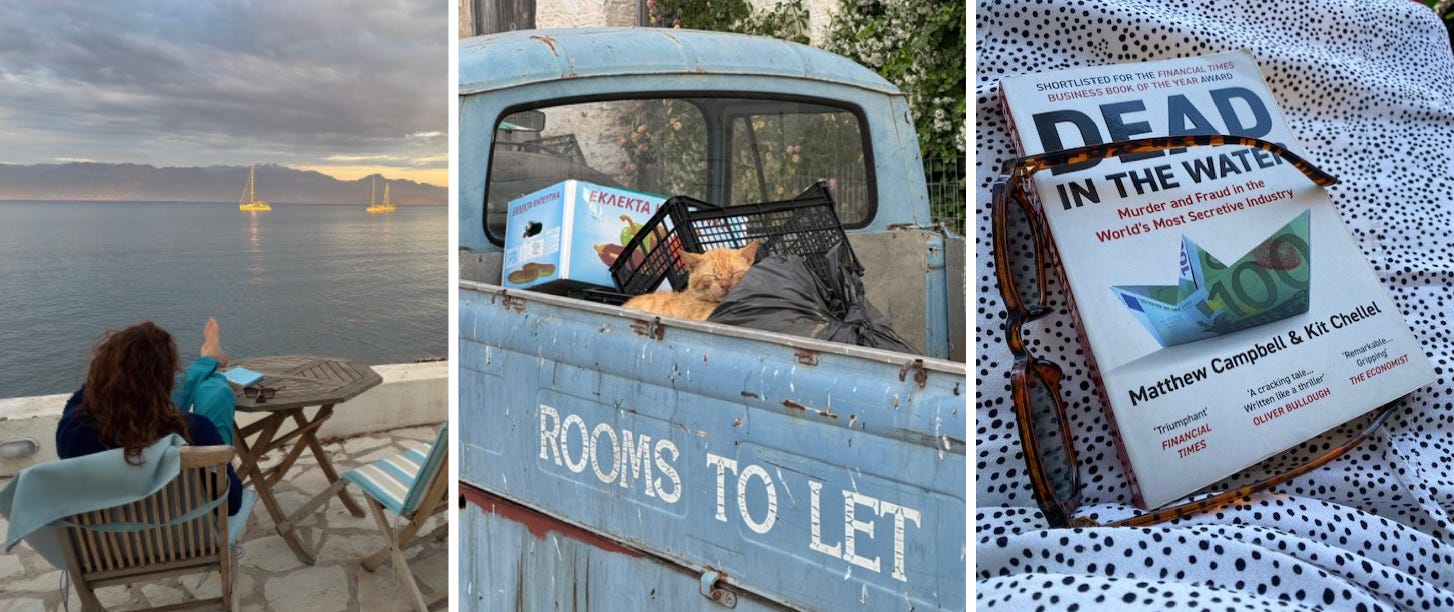
That brings me back to the sandy beach I am writing this from. A book recommendation – perfect for looking out over the Greek waves — “Dead in the Water: A True Story of Hijacking, Murder, and a Global Maritime Conspiracy”, brilliantly reported and written by Bloomberg reporters Matthew Campbell and Kit Chellel.
The book tells the tale of the Brilliante Virtuoso through first-hand accounts of those who lived it – from the ship’s crew and witnesses to the attacks, to David Mockett, a murdered maritime surveyor working for Lloyd’s of London, and the detectives turned private investigators seeking to solve Mockett’s murder and bring justice to his family.
Εβίβα,
Ingrid
Ps. still not done with shipping and Greece? Read this brilliant article (2020) “The Vampire Ship” – about a seizure of Europe’s largest heroin shipment - from Aleksander Clapp.
What else is new?
Gulf Investors in Bosnia – Dream or Nightmare? What about a nice villa on top of a Bosnian forest-topped mountain? Isn’t that what many dream of? Well, wake up, because an excellent new investigation by BIRN and ARIJ – coordinated by Alena Beširević – reveals how investors from the Gulf buy up land in Bosnia, then sell it, mostly to people from Kuwait. Seems legit, but it’s often simply an elaborate scam. They sell the land for new homes, but according to the law, they cannot be built. The land is, for example, meant for agriculture. In some cases, the planned villas were illegally built, in other cases the Arab buyers were left completely empty handed.
The end of Schmidt. After five years of his term as the High Representative in Bosnia-Herzegovina, the envoy tasked with overseeing the 1995 peace plan, Christian Schmidt announced he is going to step down for personal reasons. But just two weeks later he confirmed the rumors: there was enormous pressure from the US. It could be because Schmidt didn’t want a controversial gas pipeline. Or maybe because Trump wants an envoy who will abide more to his requests in general. Schmidt was unpopular with almost everybody in Bosnia anyway, so most people aren’t so sad to see him going.
The big question: who will be his successor? The name floating around is Antonio Zanardi Landi, an Italian diplomat who has held posts in Belgrade and Moscow before (and who since a few days has a Wikipedia page). But most probably the steering board, which includes delegates from the EU, will not agree. To be continued.
Republika Srpska paid Washington lobby firms. Schmidt was a target in an aggressive lobbying campaign in the U.S. paid for by Republika Srpska (RS), reporters from the Organized Crime and Corruption Reporting Project (OCCRP) revealed. The campaign aimed at wider goals, but Schmidt’s removal and the closure of his office was cited specifically. OCCRP analyzed U.S. Foreign Agents Registration Act filings and found that RS paid at least $8.9 million to 11 Washington lobbying firms in 2025 and 2026 to improve the image of the territory, and build support for secession.
EU’s Montenegro-language-dilemma As Montenegro edges closer to EU membership, a unique linguistic puzzle is drawing attention, writes Radio Free Europe/Radio Liberty.
Montenegrin is similar to Croatian (think British and American English), but language politics run deep. Because the EU guarantees that the national language of a member state becomes an official EU language, will Brussels be forced to spend millions translating duplicates, or will they find a political workaround?
A shooting in an upscale restaurant and a Serbian police scandal. A shooting in an upscale restaurant in Senjak, Belgrade, has triggered a scandal hitting Serbia’s police. According to Deutsche Welle, Belgrade police chief Veselin Milić organized a reconciliation meeting between two opposing crime clans in the restaurant in May. Instead of reconciliation, one of the criminals kills the other with a gun. Milić, DW reported, then covered up the crime. Serbian media reported that the body of the murdered man was found burned in Šimanovci, 30 kilometers from Belgrade.
Meme of the month
Whenever we question ourselves why we have a newsletter about the Balkans:
Tips of the month
Just watch these cool videos of brutalist buildings in Belgrade:
Hi, from us
We’re Ingrid & Marjolein, two journalists writing about the Balkan and beyond. One Saturday night — after a few glasses of rakija, yes — this newsletter was born. In each edition, we share stories that catch our eye, the ones that are worth reading, with our observations from reporting in the region. So grab a coffee (or a rakija) and join us.

🖤🖤🖤